Is my concept tree any good?
The most important question this library answers, and the one that per-feature SHAP cannot ask at all. When someone hands you a concept tree (or when you draw one on a whiteboard), you want to know whether the concepts actually correspond to clusters in the data and to groups the model treats together. The Part-E diagnostics answer that.
When to use this
- Immediately after building or revising a concept graph, before any downstream analysis.
- When the structure view returns a counter-intuitive ranking — often the tree, not the model, is the problem.
- Before defending the tree in a tree-design review, a model-risk meeting, or a regulatory submission.
The four views
| Function | Operates on | Diagnoses |
|---|---|---|
feature_correlation + correlation_block |
Raw X |
Within-concept coherence; concept-boundary leakage. |
nullity_correlation + correlation_block |
X.isna() |
Do features inside a concept go missing together? |
shap_correlation + correlation_block |
shap_values |
Does the model treat features inside a concept as substitutes? |
coherence_importance + coherence_importance_scatter |
X + shap_values |
The single chart: well-designed vs kitchen-sink vs redundant vs noise. |
All four return either a CorrelationResult (block matrix +
per-block stats) or a DataFrame consumed by the same family of
plots.
Minimal example
from concept_graph_xai import (
    coherence_importance, coherence_importance_scatter,
    correlation_block, feature_correlation,
    joint_missing_map, joint_missing_rate,
    nullity_correlation, shap_correlation,
)

# 1. Are the concepts coherent?
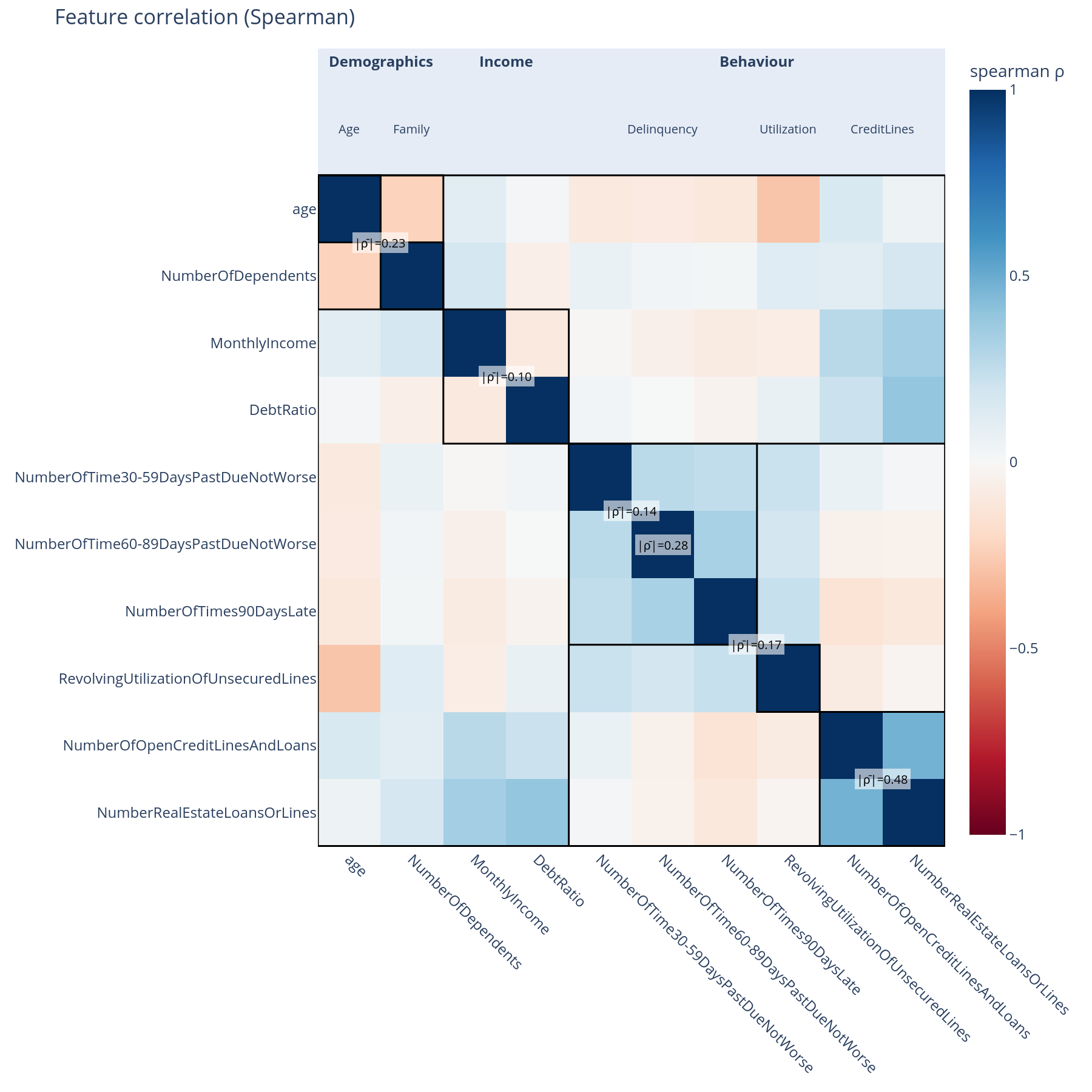
fc = feature_correlation(graph, X, method="spearman")
correlation_block(fc, title="Feature correlation").show()

# 2. Does the model treat them as such?
sc = shap_correlation(graph, feature_names, shap_values)
correlation_block(sc, title="SHAP correlation").show()

# 3. The headline diagnostic — coherence vs importance.
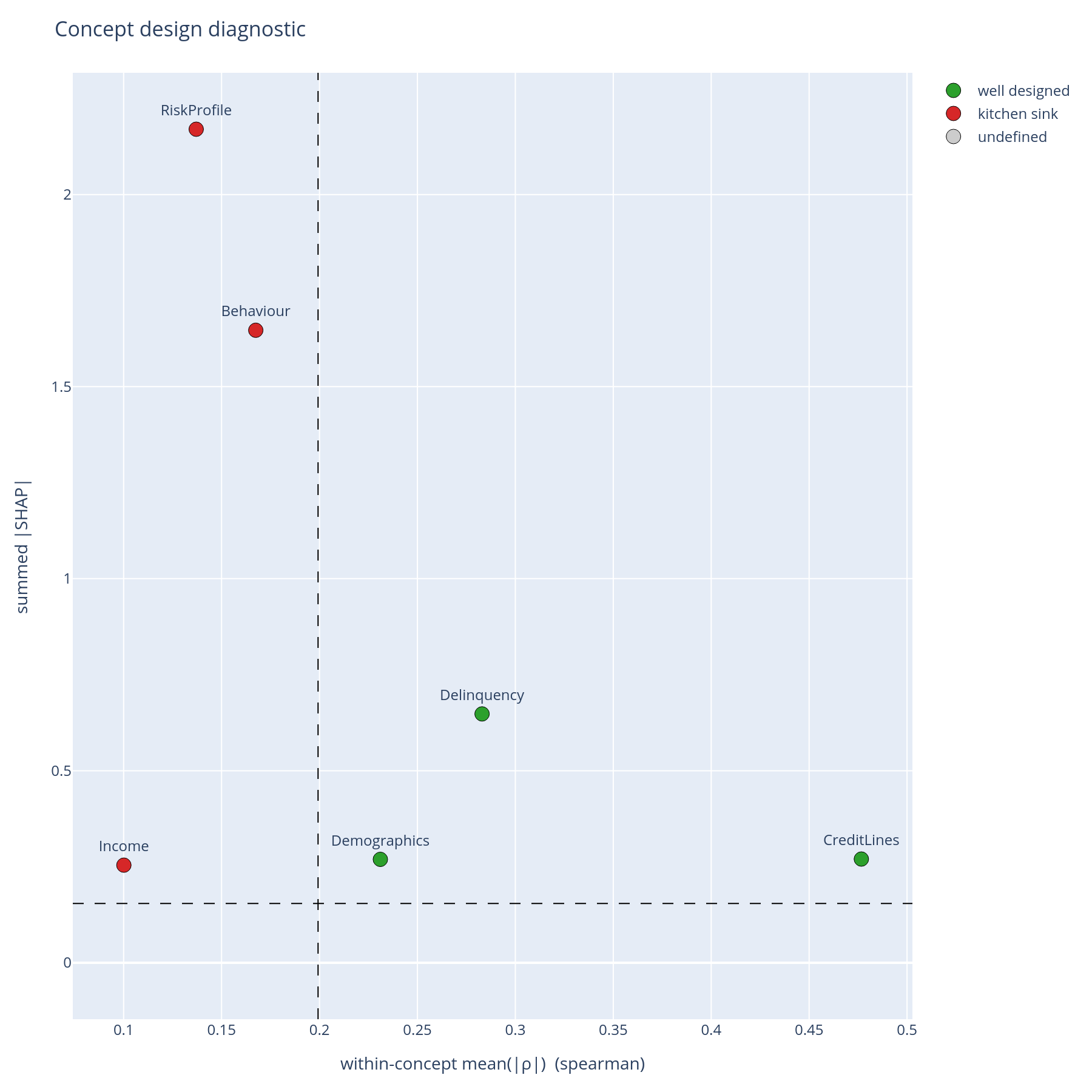
coh = coherence_importance(graph, X, feature_names, shap_values)
coherence_importance_scatter(coh).show()

# 4. Do whole branches go missing together?
correlation_block(nullity_correlation(graph, X),
                  title="Nullity correlation").show()
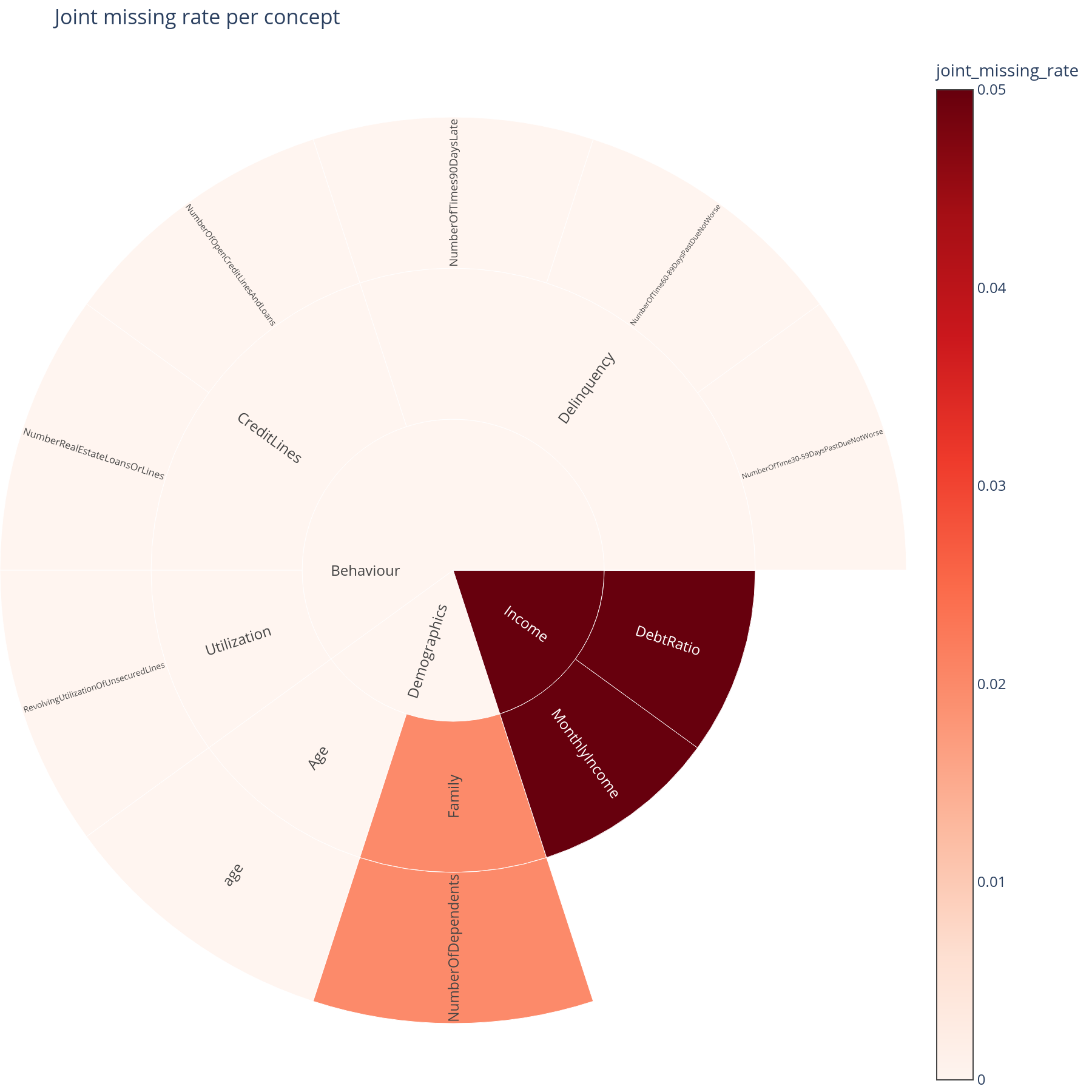
joint_missing_map(graph, joint_missing_rate(graph, X)).show()
Reading the block heatmap
Features are reordered along the graph's DFS preorder, so every concept's descendants form a contiguous block. The plot draws separator lines between top-level concept blocks and annotates each diagonal block with its mean(|ρ|).
A "good" tree under feature correlation typically looks like:
- dark, high-correlation diagonal blocks (within-concept coherence);
- mostly white off-diagonal blocks (concepts are different things).
Boundary leakage shows up as a high off-diagonal block — two concepts that are more correlated with each other than with their internal features. That is a tree-design problem, not a model problem.
When feature_correlation and shap_correlation disagree, that is
informative, not a bug:
- Two raw-uncorrelated features can be SHAP-redundant (the model treats them as substitutes) when one is a transformation of the other the model approximates internally, or when they encode the same upstream signal through different representations.
- Two raw-correlated features can be SHAP-different when the model uses them in opposite directions in different parts of the input space.
Reading the headline scatter
One point per concept. X = within-concept mean(|ρ|), Y = summed |SHAP|. Dashed lines at the medians cut the plane into four quadrants:
| Quadrant | What to do |
|---|---|
| Well-designed (high coherence, high importance) | Keep. Document. |
| Kitchen sink (low coherence, high importance) | Split. The model relies on this concept but the concept itself is heterogeneous — there are probably two or three sub-concepts hidden inside. |
| Redundant (high coherence, low importance) | Merge or drop. The features within are coherent (they really are one concept), but the model does not lean on them. |
| Noise (low on both) | Drop. Adds bookkeeping cost without explanatory value. |
The default thresholds are the medians across concepts; pass
coherence_threshold= and importance_threshold= to use absolute
cutoffs (the median is a sensible default but yields trivial
quadrants on a tree with very few concepts).
Reading the missingness views
feature_correlation and shap_correlation answer "is the tree
shape right for this data and this model". nullity_correlation and
joint_missing_rate answer "if a concept's data goes missing, does
it tend to do so as a whole block?".
If the nullity-block diagonals are dark, the "whole branch missing"
scenario simulated by auc_drop is realistic, and the
AUC-drop view should be taken seriously. If they are light,
single-feature outages are far more common than block outages and the
simulation is overly pessimistic — the action is to weight the
AUC-drop numbers by joint-missing-rate before quoting them in the
operational-risk register.
What to do with the answer
- Open with the coherence-vs-importance scatter in any tree-design review. It is the one chart that says, in 12 dots, whether your tree is defensible.
- For any concept in the kitchen-sink quadrant: split it into sub-concepts before doing further analysis. The next round of metrics will be more honest with a refined tree.
- For any concept in the redundant quadrant: confirm with a domain expert before dropping — many regulatory or business reasons to keep a concept anyway.
- Pair the AUC-drop numbers from robustness with the joint-missing-rate sunburst before turning them into operational thresholds.
What this is not
- Not a way to derive a tree from the data. There are good
clustering tools for that (
shap.utils.hclust,seaborn.clustermap); using them after building a business-driven tree just produces a different tree, not feedback on the one you wrote. - Not a substitute for a domain-expert review. The diagnostic flags concepts as "kitchen sink" or "redundant" given the data and the model. Many regulatory or business reasons exist to keep a concept anyway.
Related
feature_correlation,shap_correlation,nullity_correlation,coherence_importance,joint_missing_rate— API reference.- Structure — the importance and utilization views that operate on the tree you validate here.
- Robustness — the AUC-drop view that the joint-missing-rate calibrates.
- Tour, Part E — the same answers in narrative form.