Run the search
Shared objects
Snippets on this page continue from the objects the quickstart builds with
credit_demo(): exp, x, target, X_bg, the solved res and batch, and cal,
a fitted monotone calibrator (see the FAQ).
With the model, target, and constraints in place, this page is the middle of the workflow: producing plans — for one row, for alternatives per row, and for a whole dataset. Three calls produce more than one plan for a row; pick by what you want the plans to differ in:
| You want | Call |
|---|---|
k fast heuristic variants of one plan |
explain_batch(x[None], n_per_example=k, diversity=...) |
| One plan per group of levers you already know | explain_coalitions(x, target, coalitions={...}) |
| Plans with distinct lever sets, each with a proof, or the whole picture of which lever sets work | explain_diverse / recourse_menu |
One row
res = exp.explain(x, target=target, seed=0)
res.changes    # {"feature": (from, to)} — only what changed
res.distance   # the weighted cost of the plan
res.proof      # "heuristic" — the default backend makes no optimality claim
The default backend is the genetic search on the bundled Rust core;
backend="exact" upgrades the answer to a proof and is the subject of
certify and widen. Either way the result is a
Counterfactual or an Infeasible — check with isinstance, and read
Infeasible.reason when nothing was found.
Alternatives for one row
Two diversity modes produce genuinely different plans instead of one plan with noise:
diversity="seeds"re-runs the stochastic search from different seeds and keeps distinct outcomes.diversity="lever-blocking"solves once, then re-solves with each used lever frozen in turn — "and what if I cannot touch utilization?" answered systematically.
alts = exp.explain_batch(x[None], target=target,
                         n_per_example=3, diversity="lever-blocking", seed=0)
[(rec.blocked_lever, rec.changes) for rec in alts.records if rec.feasible]
Grouped levers: coalitions
explain_coalitions restricts the search to named feature groups and solves
each group independently — the answer to "what can this applicant do through
debt reduction alone?":
plans = exp.explain_coalitions(
    x, target=target,
    coalitions={"repayment": ["utilization", "dpd_12m"],
                "profile": ["income", "tenure_months", "occupation"]},
    include_full=True, seed=0,
)
sorted(plans)   # ["(all levers)", "profile", "repayment"]
Semantics and comparison plots: Coalitions.
Recourse menus and diverse plans
recourse_menu solves every lever set up to a size as its own coalition and
returns the whole picture at once — which combinations of levers reach the
target, at what cost, and which provably cannot:
menu = exp.recourse_menu(x, target=target, max_levers=2, backend="exact", seed=0)
menu.minimal              # the cheapest lever sets no smaller set can replace
menu.certified_infeasible # sets no acceptance is reachable through, proved
menu.complete             # True: every set up to two levers was settled with a proof
menu.describe()["dpd_12m"]   # "no acceptance is reachable by changing only dpd_12m"
The candidate levers are the features the search would branch on for this
applicant (not frozen, more than one candidate value, influential). Entries
are keyed by the features each plan actually changed, sorted and joined
with +, so a menu is a mapping in the same shape explain_coalitions
returns and every plot that takes one takes a menu. The default
mode="minimal" skips any set that contains a set already found feasible
— feasible by monotonicity, and not minimal — and lists the frontier in
menu.minimal; mode="all" solves every set. menu.complete certifies
one precise thing: every enumerated set was settled with a proof (an
optimal plan, or a certified infeasibility) and none was cut off by
total_budget_s. The genetic backend never certifies, so its menus are
never complete.
explain_diverse reads the k cheapest plans off that menu. Diversity
here means distinct lever sets — two plans count as different ways to
reach the target when they change different features — and nothing else:
diverse = exp.explain_diverse(x, target=target, k=3, backend="exact", seed=0)
list(diverse)        # plan keys, cheapest first
diverse.jaccard      # pairwise distance between the plans' changed sets
diverse.complete     # False: k plans came back, so more distinct lever sets may exist
diversity="coalitions" with the explain_coalitions group form solves
each declared coalition as itself and reaches for unions of groups only
when fewer than k are feasible. The matrix view of a menu is in
visualize.
A whole dataset
explain_batch runs thousands of rows in parallel inside the Rust core and
returns a BatchResult with per-row records, portable JSON storage, and
plotting hooks (visualize):
batch = exp.explain_batch(X_bg[:20], target=target, seed=0)
sum(r.feasible for r in batch.records)   # rows with a plan
frame = batch.to_frame()                 # one row per (id, plan), pandas
batch.save("batch.json")                 # inert JSON; every 0.x release reads it back
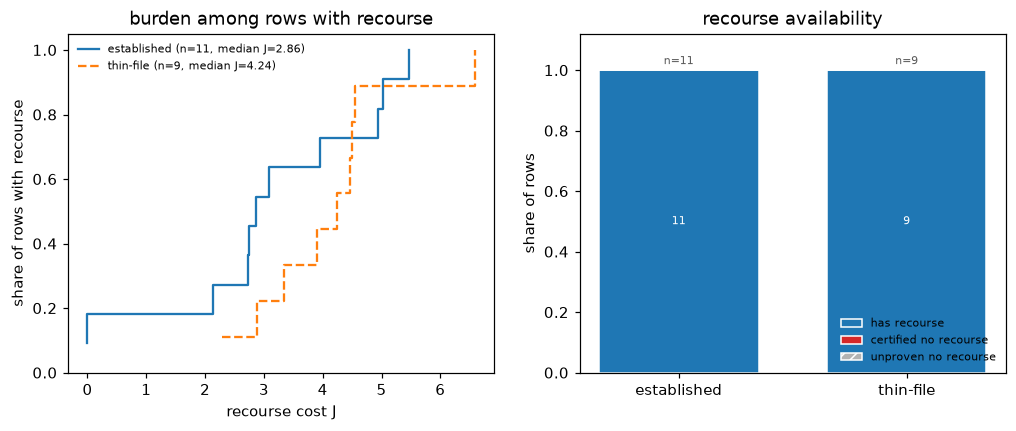
plot_recourse_burden splits a campaign's outcome by any per-row segment
label — feasibility share and cost distribution together
(visualize):
The exact-batch opt-in
explain_batch(..., backend="exact") loops the single-row exact solve —
there is no vectorized exact engine — so its wall time is
rows × plans × time_budget_s in the worst case, where plans is
n_per_example (or the coalition count). Because that is easy to
underestimate from one fast explain call, the batch path refuses to run
without allow_exact_batch=True and names that arithmetic, hours-formatted,
in the error. The full behavior — including how the shared warm start
differs from sequential explain calls — is in
Certification — the exact-batch opt-in.
Next
When a plan needs to carry a proof — optimality, certified infeasibility, or a whole certified region — move to certify and widen.