Certify and widen
Shared objects
Snippets on this page continue from the objects the quickstart builds with
credit_demo(): exp, x, target, X_bg, the solved res and batch, and cal,
a fitted monotone calibrator (see the FAQ).
The default backend returns a good plan; backend="exact" returns a plan
with a claim — proved cheapest, cheapest within a stated gap, or certified
impossible — and region=True widens a point plan into a certified box.
This page is the workflow; the boundaries of the claims are in
Certification.
Prove optimality
from treecf import Counterfactual, Infeasible

res = exp.explain(x, target=target, backend="exact", seed=0)
if isinstance(res, Counterfactual):
    res.proof   # "optimal" — no cheaper feasible row exists in the searched grid
elif isinstance(res, Infeasible):
    res.proof   # "certified" (nothing exists) or "search_exhausted" (budget ran out)
Read proof, never just the presence of a row: the exact backend reports
"heuristic" honestly when a conservative constraint repair had to withdraw
the optimality claim
(the honesty notes).
Budgets, gap, warnings
Three arguments control how hard the search works, and every degraded outcome warns rather than passing silently:
time_budget_s(default 10.0) andnode_budget(default 2,000,000) cut the search off; a cut always emits aTreecfWarningnaming the cause and the result downgrades to best-found.gap=0.05accepts a plan provably within 5% of the optimum, reported asproof="optimal_within_gap"— usually a large speedup for the last few percent of proof.warm_start=True(default) seeds the search with a short genetic pass; it changes speed, never the claim.
Presolve — a reachability filter that discards candidate values no tree can
respond to — runs before every exact search and is reported in
solver_stats["presolve_removed"]; when it empties a feature's domain
entirely it certifies infeasibility without expanding a single node
(how presolve works).
Refine the search
search="refine" — the default; search="classic" selects the earlier
engine — runs the exact backend coarse-to-fine. Instead of trying one candidate value per
feature at a time, it first holds each numeric feature to a range of
routing cells — at most eight per feature — and only splits a range where
the score bound cannot decide the whole box. A box whose bracket lies inside
the target and whose representative row passes every constraint is accepted
at its true minimum cost without looking inside; everything else is refined
down to the atomic cells the classic search would have visited, and settled
by exactly the same rules. The claim is the same — proof="optimal", a
certified Infeasible — and so is the optimal cost; the returned row may be
a different argmin of that cost, and solver_stats records search,
coarse_accepts, and refinements:
res = exp.explain(x, target=target, backend="exact", search="refine", seed=0)
res.proof                              # "optimal" — the same claim as the classic search
res.solver_stats["search"]             # "refine"
res.solver_stats["coarse_accepts"]     # boxes accepted whole, without descending into them
res.solver_stats["refinements"]        # ranges split because the bound could not decide them
Refine pays off where features carry many thresholds: the benchmarks
page shows both engines side by side on the
same solves. Budgets, gap, warm start, and the degradation warnings work
identically in both modes.
Widen to a region
region=True grows a certified box around the plan: per-feature intervals —
and, for categorical features, sets of category codes — within which every
row still satisfies the target and constraints:
res = exp.explain(x, target=target, backend="exact", region=True, seed=0)
res.region.feature_intervals    # {"income": (lo, hi), ...} — certified intervals
res.region.feature_categories   # {"occupation": (1, 2)} — certified category codes
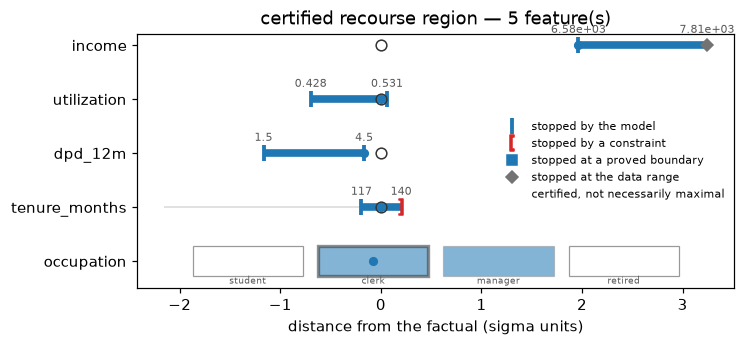
A side no constraint bounds stops at the observed range of the explainer's
background data (res.region.data_limited names those sides), so an
unconstrained feature reads in [0, 1) rather than < 1 over an implicit
minus infinity; add a Range where the domain is known.
Regions are sound but not monotone in the target interval, and in the
default fast mode not maximal either —
the fine print.
plot_region in visualize draws the box with what stopped
each bound.
Prove the boundary
region_mode="maximal" (opt-in; the default "fast" is unchanged) settles
every side the fast growth stops. Fast mode stops a side as soon as the
conservative interval bound of the enlarged box fails; maximal mode then
asks the sharper question — does the next routing cell on that side contain
any point that leaves the target or breaks a constraint? — and answers it
with a budgeted search for such a point. Three outcomes, per side:
- the search completes and finds none: the side extends and keeps growing;
- it finds one: the side is proved — recorded in
RecourseRegion.maximalas(lower proved, upper proved)per feature and inmaximal_categoriesper categorical feature — and the point is kept as a witness when you ask for it; - it spends its
region_budget(search nodes per side, default 100 000): the side is left unproven, which is what fast mode reports for every side.
res = exp.explain(
    x, target=target, backend="exact", region=True, region_mode="maximal", seed=0
)
res.region.maximal              # {"income": (True, True), ...} — what each side proved
res.region.describe()           # phrases end in "(maximal)" where every side is proved

proved = exp.recourse_region(x, res.x_cf, target, mode="maximal", keep_witnesses=True)
proved.witnesses                # {"income:hi": point, ...} — one violating point per proved side
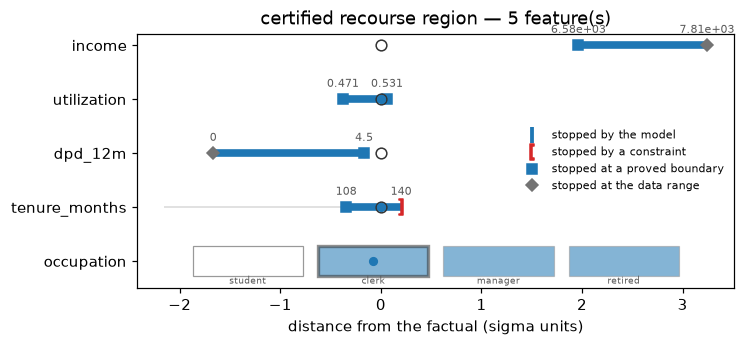
"Proved" is a precise, local claim: the region cannot be extended into the
next cell on that side without some point leaving the target or breaking a
constraint, given every other coordinate ranges over the box as certified.
A different box that also shrinks another feature is not ruled out, and a
maximal region need not contain the fast one — an early extension on one
feature can make a later extension on another genuinely unsound. The
emptiness search reuses the refine engine's machinery because a maximality
claim needs a certificate, not a tighter bound; it can cost up to
region_budget nodes per side per feature, each a partial ensemble walk.
Watch the proof form
Every exact solve records a certification trace in
solver_stats["trace"]: (nodes_expanded, incumbent_cost, lower_bound)
sampled at every incumbent update and every power-of-two node count, plus
one terminal sample, capped at 256 entries. The lower bound is the sound
bound the search holds at that moment; the incumbent is the cheapest row it
has found. plot_certification_trace draws the two against the node count:
import warnings

from treecf import TreecfWarning
from treecf.viz import plot_certification_trace

with warnings.catch_warnings():
    warnings.simplefilter("ignore", TreecfWarning)   # a cut-off search warns, by design
    cut = exp.explain(   # the classic engine, cut off by a small node budget on purpose
        x, target=target, backend="exact", search="classic", seed=0,
        node_budget=50_000, warm_start=False,
    )
plot_certification_trace(cut)   # incumbent stepping down, the bound below it, the outcome named
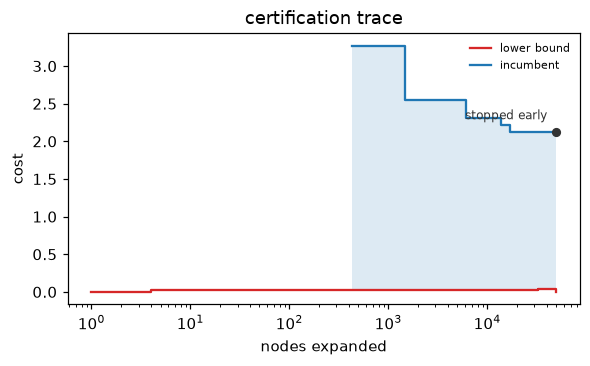
The terminal label is the claim: optimal, within gap, certified
infeasible, or stopped early for a search that ran out of budget or
withdrew its claim — the solve-time warning names which.
Size the search
Explainer.search_profile(x) says how large the space a classic search
would enumerate is, before any search runs: per feature, its kind, the
number of atomic routing cells (or category blocks), the number of candidate
values left after the instance bounds, and whether the search branches on it
at all; in total, the number of influential features and log10_states, the
exponent of the number of complete assignments. With a target, presolve runs
too and reports the filtered sizes and whether it certifies infeasibility
outright. The budget-exhaustion warning quotes the same figure.
profile = exp.search_profile(x, target)
profile["influential_features"]         # features the search would branch on
profile["log10_states"]                 # 10**this complete assignments, at most
profile["presolve_certified"]           # presolve alone proved the target unreachable?
Next
A proof is only worth what a third party can re-check: make it auditable. The search itself was set up in run the search.