treecf
Constrained, threshold-aware counterfactual explanations for tree ensembles.
treecf answers: "what is the minimal, feasible change to this instance such that the
model's output lands in a target interval?" — for XGBoost, LightGBM, CatBoost and
scikit-learn tree ensembles.
from treecf import Explainer, Target
from treecf.datasets import credit_demo   # a packaged model, background rows, one declined row

model, X, x = credit_demo()
exp = Explainer(model, background=X)
res = exp.explain(x, target=Target.probability(range=(0.0, 0.05)), seed=0)
res.changes   # {'income': (4678.0, 6932.4)}
Why treecf
- Tree-native and fast. Models parse into one tree IR and the search runs on a bundled Rust core, typically in milliseconds on 300-tree ensembles; every result is float-verified against the parsed model, and the parsers are conformance-tested against the native library (how it works).
- Proofs, inside a measured envelope.
backend="exact"returnsproof="optimal"under the declared objective, a certified infeasibility, or a certified recourse region — a box every point of which is verified — with no external solver. Proofs scale with the levers the search may move, not the model's width: wide models certify once the levers are restricted, and a search that runs out of budget says so (the proof envelope). - Declarative constraints.
Freeze,Monotone,Range,OneHot, and linear rules such asmax_dpd_30d <= max_dpd_12m, compiled once for every engine (constraints). - Auditable output. A self-contained JSON certificate a validator re-checks with
check_certificateyears later, and a one-page portfolio report for a whole campaign (auditability).
On a 120-tree model and 100 declined rows, treecf's plans cost a seventh of DiCE's at a fifth of the time; NICE is four times faster per instance and its plans cost 2.7 times more. The measured tables and the honest reading are on the benchmarks page.
Use it if your model is a tree ensemble and you need plans that are feasible under real constraints and cheap, with a proof when the levers are few. Look elsewhere if the model is not a tree ensemble, if you want sets of plans diverse by distance rather than by the levers they use, or if you need a proof over dozens of free levers without restricting them.
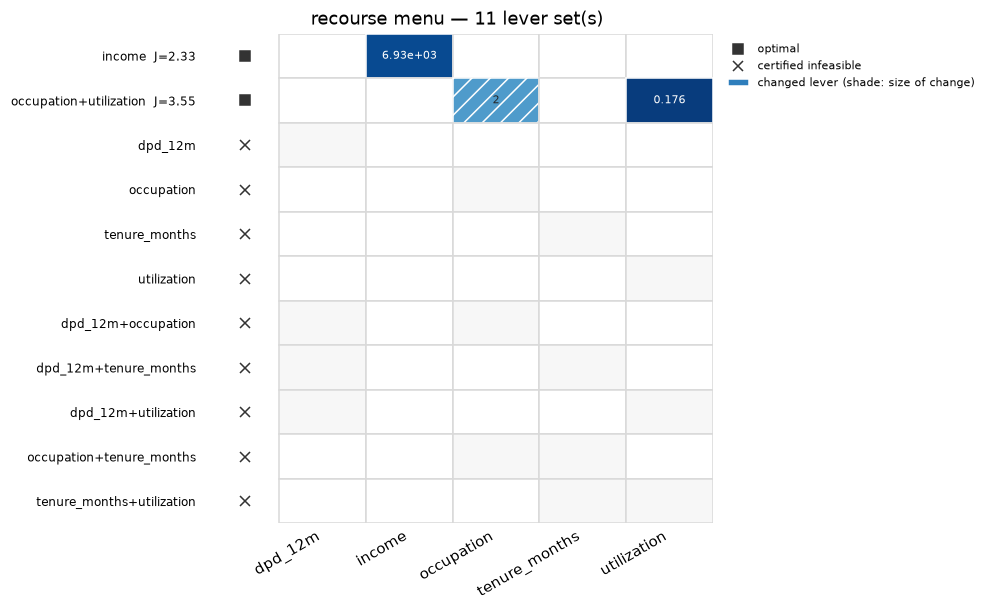
Also in the box: missing values as first-class counterfactual values, plausibility as a hard constraint, batch production, coalitions, native categorical features, the probcal calibration integration, the refine search, the maximal region mode, the certification trace, the portfolio report, and certified recourse menus — all reached from the guide.
Where to start
- Getting started — install and your first counterfactual in five minutes.
- Tutorials — runnable notebooks, from quickstart to a credit-risk batch workflow.
- Deep dive: how it works — the full pipeline, from objective to verified answer.
Contributions are welcome — see CONTRIBUTING.md; security reports go through SECURITY.md.